

Established in 1988, CEMA was one of the first ethnic-focused archival collecting initiatives within a California university library. CEMA is a permanent program that advances scholarship in ethnic studies through its varied collections of primary research materials. These unique collections document the lives and activities of African Americans, Asian/Pacific Americans, Chicanos/Latinos, and Native Americans in California. The collections represent the cultural, artistic, ethnic, gender, and racial diversity that characterizes the state's population.
CEMA is recognized globally for its representation of the visual and performing arts within its collections, holding the institutional records of Self Help Graphics, Royal Chicano Air Force, El Teatro Campesino, and Asian American Theater Company, as well as the personal papers of Shifra Goldman, Iris Chang, and Sojourner Kincaid Rolle, among many others.
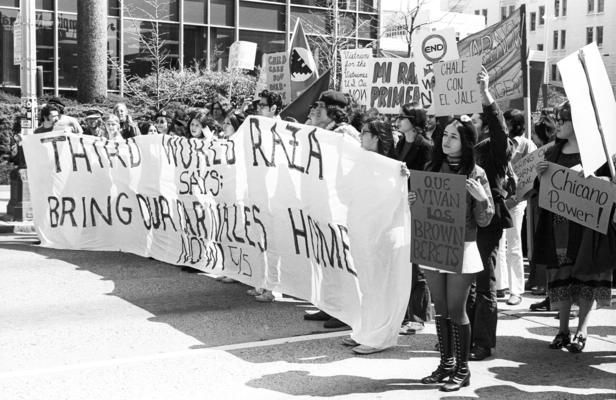 Photograph found in the Antonio Salazar Chicanismo Photograph Collection (CEMA 177).
Purpose
CEMA was established to:
- Enable and enhance research efforts to study the ethnic and racial diversity of the state and nation and attendant demographic and social issues
- Support study and research in many disciplines, such as art, history, literature, sociology, political science, and economics
- Enrich the academic work of the ethnic studies departments in the University of California
- Enhance the recruitment of underrepresented faculty and students
- Develop monographs, exhibition catalogs, and other publications
- Ensure, by preserving the materials, that future generations have access to the important historical documents
Collecting Priorities
CEMA’s coverage is limited to the state of California–therefore collections must represent persons, organizations, issues, or other activities related to African Americans, Asian/Pacific Americans, Chicanos/Latinos, and Native Americans from within the state. There are two categories of materials which form CEMA: personal papers of individuals including correspondence, diaries, speeches, photographs, manuscripts, and ephemera; and organizational records that document the history of an institution including reports, minutes of meetings, agenda, memoranda, and publications.
Acquisitions in any language representative of the four ethnic groups listed above may be accepted. We can accept digital surrogates of originals when appropriate.
Actively Collected Materials
We are currently actively seeking:
- Materials that compliment existing CEMA collections
- Visual arts and Performing arts (film, music, dance)
- Literature
- Car culture
- Politics, leadership, and activism
- Social service providers
- Health (including mental health) services
- Environmentalism
- Immigration, migrant communities, Indigenous migrant communities in California
- Ethnic communities and figures in Santa Barbara County
- Minoritized LGBTQ+ communities
- Cross-cultural interaction, movements, and coalitions
Selectively Collected Materials
- Books, newsletters, magazines, and other published materials that pertain to the above collecting priorities based on the rarity of their content (not form) as well as their research or instruction value.
- Selectively accepting graphic art prints from collectors/non-creators
Exclusions
- Paintings or monotypes in oil
Chancellor's Statement on CEMA
Curator
Angel Diaz